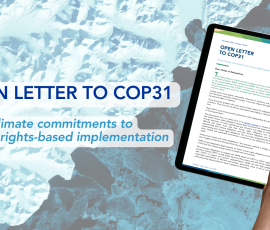
GANHRI calls on States to put human rights at the centre of COP31
Ahead of the UN Climate Change Conference (COP31), GANHRI today published an open letter calling on States to put human rights at the heart of their climate decisions.


Emerging technologies are reshaping societies, with far-reaching effects on rights such as freedom of expression, privacy and equality, as well as on civic space.
A new UNESCO-GANHRI brief offers national human rights institutions (NHRIs) practical guidance on using existing tools to monitor and assess national digital environment and address related human rights risks.
Launched at a joint side event during the 63rd session of the Human Rights Council, sponsored by the Permanent Mission of Australia, the brief was the starting point for a discussion on how NHRIs can turn digital rights evidence into concrete changes and policies.
The event opened with remarks from Ambassador Clare Walsh, Permanent Representative of Australia, noting that digital technologies can advance rights by fostering communication and inclusion, but can also undermine them through disinformation, algorithmic bias, privacy violations, and restrictions on civic space. She stressed the important role of NHRIs in safeguarding human rights online.
Tatevik Grigoryan of UNESCO called for a human-centered, rights-based approach to digital transformation. She presented two UNESCO frameworks:
Catalina Martinez of GANHRI explained how NHRIs can apply these tools in practice. ROAM-X indicators allows institutions to “zoom out” from individual cases and see the bigger picture of their national digital environment, while the HRIA Guidance helps them “zoom in” on the impacts of specific platforms. Used together, they can help NHRIs link individual cases to wider patterns, strengthen monitoring, and inform recommendations to public authorities and other relevant stakeholders.
Andreas Salz of the German Commission of UNESCO shared Germany’s experience: bringing stakeholders together for the assessment, mapping the national digital landscape, and issuing targeted recommendations for each stakeholder and dimension covered. While influencing policy remains a challenge, he welcomed the government’s renewed interest in digital issues.
Muhammad Farooq Khan of the Ethiopian Human Rights Commission drew on the institution’s digital rights work to identify recurring patterns of violations. He showed how the ROAM-X Indicators could help link individual complaints to systemic monitoring. This illustrates how NHRIs can build an evidence-to-action process: documenting complaints, identifying patterns, issuing recommendations, and following up on their implementation.
Birgit Kainz-Labbe of OHCHR reminded participants to keep the needs of people at risk at the centre. Consultations with journalists and human rights defenders point to growing obstacles online, including restrictive legislation and pervasive surveillance. She called for stronger digital expertise within NHRIs and greater attention to data protection and privacy.
As digital environments evolve, NHRIs can contribute to ensuring that human rights standards inform digital policies and practices. GANHRI will continue working with UNESCO to strengthen NHRIs’ capacity to monitor, protect and promote human rights in digital environments


Ahead of the UN Climate Change Conference (COP31), GANHRI today published an open letter calling on States to put human rights at the heart of their climate decisions.

GANHRI, the Regional Networks, and member NHRIs took part in the second session of the Intergovernmental Working Group (IGWG) on the Human Rights of Older Persons , held in Geneva from 26 to 30 October 2026. The session marked the start of discussions on the substance of a future legally binding instrument.
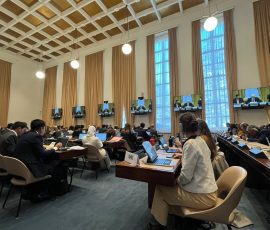
From 12 to 16 October 2026, GANHRI took part in the 12th session of the Open-ended Intergovernmental Working Group on Transnational Corporations and Other Business Enterprises with respect to Human Rights (OEIGWG) in Geneva, which continued negotiations on a legally binding instrument (LBI) on business and human rights.

The UN Human Rights Council has adopted by consensus resolution A/HRC/63/25 on NHRIs, a strong reaffirmation of support for independent and effective NHRIs and their role in promoting and protecting human rights, online and offline